


Jetstone
Poetry, Criticism and Non-Fiction
A Professional Writer-Cratur
Essays and Drafts of James Leslie Mitchell/Lewis Grassic Gibbon
Edited by William K. Malcolm
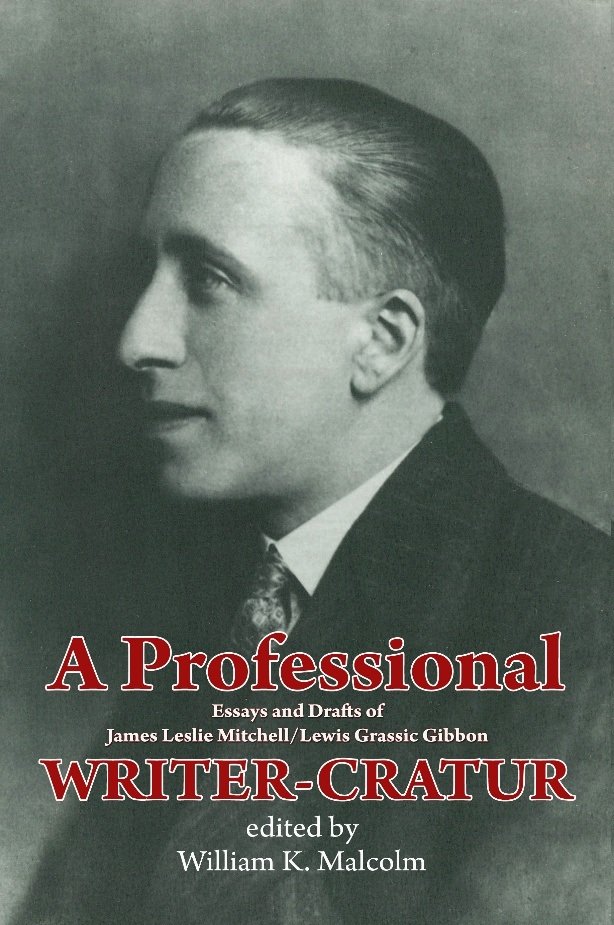
James Leslie Mitchell (1901-1935) had only six years in which to exercise his hard-won status as what he termed ‘a professional writer-cratur’. His early death the week before his thirty-fourth birthday came just three years after the publication of Sunset Song, his sensational breakout novel of 1932, which continues to earn global acclaim for the enduring pen-name of Lewis Grassic Gibbon.
This comprehensive collection of Mitchell’s essays, synopses and fragments boasts previously undiscovered riches: from erudite studies of Mesoamerican history to animated profiles of fellow authors and archly witty reviews of contemporary writing; from eager early attempts at fiction and methodical preparations for the epic trilogy A Scots Quair to tantalising snatches of an array of classic works, both fiction and non-fiction, unfinished at his death.
A Professional Writer-Cratur maps Leslie Mitchell’s colourful life in his own words and affords unique insight into the evolution of one of the most passionate and original literary voices of the twentieth century. Authorised by Mitchell’s family, the volume is expertly edited and annotated by Dr William K. Malcolm, author of History of a Revoluter: The Life of James Leslie Mitchell/Lewis Grassic Gibbon, shortlisted for the Saltire Research Book of the Year 2025.
The Correspondence of James Leslie Mitchell/Lewis Grassic Gibbon
Edited by William K. Malcolm
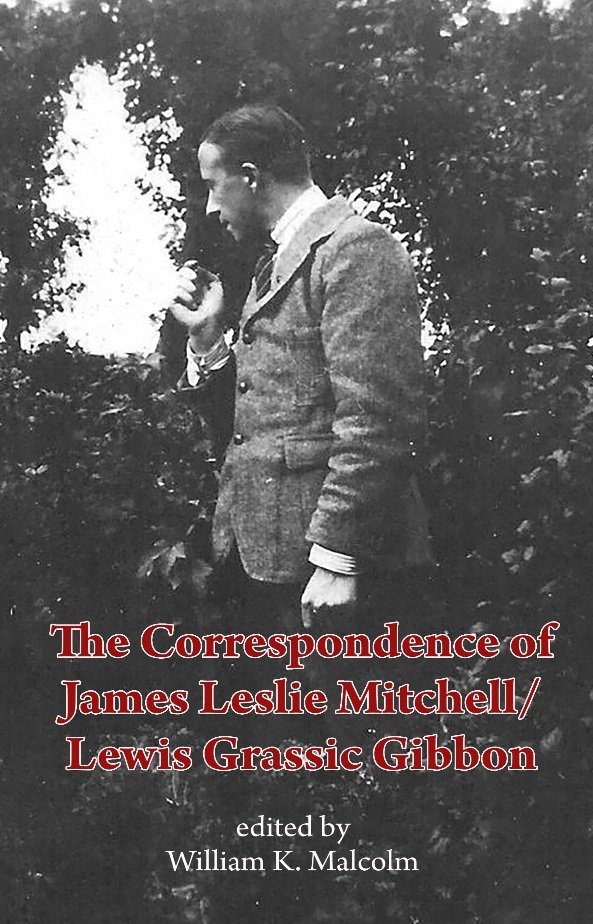
James Leslie Mitchell (1901-1935), best remembered by the pseudonym of Lewis Grassic Gibbon, is revered the world over as a major cultural figure of the 1930s, whose short life produced a body of work of astonishing range and substance, capped by his magisterial fictional trilogy of modern Scotland, A Scots Quair.
This long-awaited collection of Leslie Mitchell’s complete extant correspondence – garnered from public and private sources from all over the world – maps Leslie Mitchell’s colourful life in his own words from early adulthood to his tragically early death. By turns witty, moving, thoughtful, on occasion rash, bullish, acerbic: this volume adds authoritatively to our understanding of a truly compelling personality. Invigorating to the last, Mitchell’s letters provide incisive commentary on his life and times, on prehistory, history, culture, literature, politics. And on intimate personal relationships captured in passion-fuelled love letters plunging from bright-eyed courtship to the heartbreak of parental loss; on the complex ambivalences of being Scottish, and the unique legacy inherited by the Scottish writer; on the challenges of living in the fractured world of the 1920s and 1930s poised precariously between two world wars.
The volume makes available the fully annotated, unexpurgated primary materials which informed Malcolm’s biography History of a Revoluter: The Life of James Leslie Mitchell/Lewis Grassic Gibbon, shortlisted for Saltire Research Book of the Year 2025.
History of a Revoluter
The Life of James Leslie Mitchell/Lewis Grassic Gibbon
by William K. Malcolm
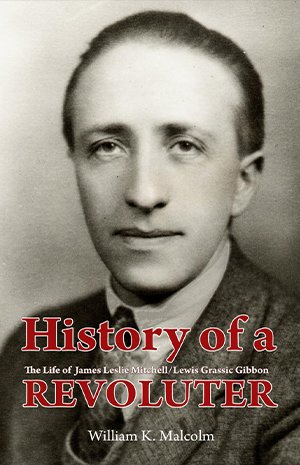
The popular acclaim of James Leslie Mitchell (1901-1935) has risen exponentially in the twenty-first century, and Mitchell’s critical standing in European literature is now assured. This is the first full critical biography, authorised by his family, of the author who found enduring fame by his pen-name of Lewis Grassic Gibbon, universally heralded for the plangent autofictional novel Sunset Song and for the epic trilogy of modern Scotland, A Scots Quair.
Dr William Malcolm has drawn on over forty years of dedicated research to lay bare the complex personality of the man behind the legend. Presenting definitive new evidence for every chapter of Mitchell’s life, this is a truly fascinating story. Of a child genius born into rural poverty spurred into action as a lifelong political activist. Of rags-to-riches success ground out from the social turbulence of the early decades of the twentieth century. Of the tragedy of a quicksilver talent cut off in his prime, already a leading light of the Modern Scottish Literary Renaissance and of the British section of the anti-fascist Revolutionary Writers of the World. And of a timeless literary legacy secured in Scotland and beyond by a writer summoning the dogged individualism of his peasant ancestry to create one of the most resonant humanitarian voices in modern literature.
Buy this book
Writing Under Fire
Poetry and Prose from Ukraine and the Black Country
Edited by Sebastian Groes, Carmel Doohan, Sofiya Filonenko and Kerry Hadley-Pryce

In this unique collection, Ukrainian writers reflect on Russia’s war against their country to understand the impact of the terror and trauma that is being inflicted. They receive responses from colleagues whose work is connected to the UK’s Black Country. Sometimes the British writers link tangentially with their Ukrainian counterparts yet at other times we find more direct, intimate conversations. The unfolding transcultural dialogue builds a literary bridge that aims to support Ukraine.
Writing Under Fire offers crafted fragments of clarity and wisdom that confront military fire power. The volume has writing by some of Ukraine’s foremost contemporary writers including Victoria Amelina, who was killed by a Russian air strike. The book presents a diverse range of perspectives, including contributions from active soldiers who send dispatches from the frontline
The twenty-one pieces use a wide variety of form and style as well as literary genres including folklore and fairy tales to give voice to an unspeakable situation. Together, they write back in protest against the inhumanity and injustice of what is being done to a sovereign people.
Buy this book
Right in the Head: My Stroke Journey
by Sebastian Groes

A stroke happens when a lack of oxygen causes damage to tissues in the brain. It is often an extremely confounding event that can shatter one’s personality as well as one’s relationship with other people and the world. A stroke triggers complex questions about the role of the brain in human behaviour, but also challenges conventional ideas about reality.
Based on first-hand experience, Right in the Head is a personal exploration of trauma and a critical investigation of art and science to understand the relationship between human beings and their brains. Encompassing psychogeography, the neuronovel, a confessional and a love story, Groes explores how stroke victims and their loved ones are confronted with the meaning of life.
Taking the shape of an existential journey, the book traces the transformation of the writer’s relationship not only to mental health, language and literature, but to life itself.
“A highly enjoyable, multi-perspectival stroke memoir that is trenchant and critical about the way ‘neuromania’ – like ‘genomania’ before it – leads people into a bogus search for a total explanation. Very engaging.” WILL SELF
“Bas Groes has returned from illness with deepened and expanded empathy, hope, and appreciation of the glorious challenges that beset humanity. This book is a log of his journey: beautiful, wise, compelling, erudite, and awestruck by the ‘self-jesting mystery’ of the mind.” NIALL GRIFFITHS
“At once touchingly intimate and wide-ranging, a beautifully written narrative of Groes's stroke and recovery that is engaging, moving and superbly informative. It is a book about the mystery of consciousness, the workings of the brain, creativity, and the overcoming of adversity.” ADAM ROBERTSListen to an Excerpt
Listen to a spoken excerpt from this book (with subtitles) on YouTube.
Buy this book
Galaktion Tabidze: A Selection of His Poems in a New Parallel Translation
translated and edited by Innes Merabishvili

This is a bilingual volume of 60 poems by Galaktion Tabidze (1891-1959), one of the greatest poets of Georgia. The English translations are by Innes Merabishvili, Professor of English and Linguistics of Translation at the State University of Tbilisi, and a well-known Byron scholar, who has rendered many of Byron’s poems into Georgian and published works on the English poet. She has also published (in Georgian) a study of Galaktion’s enigmatic metaphors in the monograph Enigmas in Galaktion’s Poetry (Tbilisi, 2003).
Amo como o Amor Ama: Escritos de Amor de Fernando Pessoa
edited by Mariana Gray de Castro

Esta antologia organizada por Mariana Gray de Castro, investigadora da obra de Fernando Pessoa, apresenta-nos um poeta praticamente desconhecido: apaixonado e carnal, cáustico e sensual, romântico e irónico e tudo. Fernando Pessoa escreveu sobre o amor em poemas, em cartas, no Livro do Desassossego e em frases soltas. Escreveu sobre o amor com sentimentalismo e com ironia, com otimisto e com pessimismo, com alegria e com sofrimento, com seriedade e a brincar. Escreveu sobre o amor antigo, o amor moderno, o amor perdido, o amor eterno, o amor romântico, o amor filial, o amor à pátria, o amor conjugal e o amor carnal. Amo Como o Amor Ama: Escritos de Amor de Fernando Pessoa contém os escritos selecionados de Pessoa sobre o amor que podem ser apreciados, a longos ou breves tragos, pelo que são: a visão de um poeta múltiplo manifestando-se sobre um dos maiores temas da arte e da vida. Pessoa ama como o amor ama, pelo menos no papel: de todas as formas possíveis e imaginárias.
“Com esta antologia o leitor é convidado a uma experiência que tem o seu quê de desconcertante: percorre inúmeros poemas e fragmentos de Fernando Pessoa ele mesmo e dos seus heterónimos em que o amor é abordado pode diz-se que em todos os registos imagináveis, do mais lírico ao mais sarcástico, do mais emocionalmente controlado ao mais aparentemente desordenado.” VASCO GRAÇA MOURA
Poetry from the Edge: Three Suffolk Poets
by R. G. Binns, Merriel Gardiner and Claire Hamburger

This new anthology of writing introduces the work of three accomplished Suffolk poets, whose work is inspired by the county’s rich variety of landscapes.
R.G. Binns lives on the Suffolk coast. His poems have appeared in The Rialto, Stand and Poetry Review and his most recent collection is The Night. He has been twice commended for the Crabbe Prize and shortlisted for the Poetry Society’s Geoffrey Dearmer Prize. “Suffolk is as far east as you can go in this land. For a poet, what better atmosphere to breathe than that of a lush, green, fertile county which reaches out into the North Sea and embraces everything from the cliffs of disappearing Dunwich to anti-tank blocks, ruined abbeys and mysterious forests?”
Merriel Gardiner lives in Lavenham. She trained in Horticulture at Rosewarne, Duchy College, Cornwall and later, Literature with Creative Writing at the University of East Anglia. She trained as Horticultural Journalist for RHS The Garden Magazine and has contributed to a variety of publications. Merriel has worked in a number of historic gardens including The Lost Gardens of Heligan, and as Head Gardener of Novikov, at Brent Eleigh Hall, Suffolk. “Many of the poems included here began life in a specific Suffolk location. I believe that at the edge of things (birth, death, love, loss, comfort and time, for example) is where we learn most.”
Claire Hamburger has worked as a teacher, counsellor and advocate. Her poems and prose have been published in a variety of anthologies including titles from Sheba Feminist Publishers, Palantir, two German anthologies and Stand. She has won poetry prizes in competitions for Café Writers, Waterstone’s Bookshop, Suffolk Poetry Society, as well as various library competitions. “I started writing poetry at an early age and have read and absorbed across cultures and time spans. My strong belief in humanity and humanitarian causes and in the relationship between nature and humanity drives my work I live life with ‘eyes wide open’ and have been immersed in the Norfolk and Suffolk landscape for many years.”
Sharply Critical
by Ellis Sharp

In this wide-ranging collection of essays and reviews, the novelist and short story writer Ellis Sharp analyses the work of novelists, poets, historians and film makers, including Ian McEwan, Paul Celan and David Lean. Topics covered include the hidden meanings of Jane Eyre, the problems involved in establishing Shakespeare’s identity and the reputations of Angela Carter, Douglas Haig and Orde Wingate. Sharp scrutinises in detail Ian McEwan’s response to the invasion of Iraq and the politics enshrined in his novel Saturday, as well as attitudes to Israel exemplified by critical responses to the novelists Aharon Appelfeld and Amos Oz. Other subjects covered include Rimbaud, Robert Mitchum, a favourite film of Stalin’s and Ann Quin’s final novel, Trypticks.
“Sharp is sui generis. At times he comes across as if he were a compound hallucination dreamed up by Iain Sinclair, William Burroughs and . . . well, himself. This might sound like an unappealing mix but I am delighted to have read him. You can trust him because beneath the zaniness, at the level of the sentence, he is very good indeed. This is not magic realism. These are the bad dreams of the twentieth century.” THE GUARDIAN
Hanno, or the Future of Exploration
by Lewis Grassic Gibbon [James Leslie Mitchell]

This is the only the second ever republication of the first book by the Scottish writer James Leslie Mitchell (better known as Lewis Grassic Gibbon). Commissioned for a popular series in futurological writing, Hanno, or the Future of Exploration looks to the decades ahead from the vantage point of 1928. Largely ignored despite its author’s later fame, the extended essay makes several startlingly accurate and some bizarrely inaccurate predictions about the coming exploration of land, ocean, the inner Earth and outer space. The text is here supported for the first time by a scholarly introduction, explanatory notes and commentary which help the reader rediscover a forgotten yet still highly readable work of a major modernist author.